


Disclaimer: Healthy Stock Picks uses information sources believed to be reliable, but their accuracy cannot be guaranteed. The information contained in this publication is not intended to constitute individual investment advice and is not designed to meet your personal financial situation. The opinions expressed in such publications are those of the publisher and are subject to change without notice. You are advised to discuss your investment options with your financial advisers and to understand whether any investment is suitable for your specific needs. From time to time, I may have positions in the securities covered in the articles on this website.
I first came across AK Medical in 2019, as I recall it, from X investor Alexander Eliasson. The investment idea was great: AK Medical a Beijing based leader in hip and knee orthopedic implants - perfectly placed to ride the tailwind of a growing elderly population. I bought shares with a lucky timing as the stock went on a massive tear - from HK$5 to HK$25 per share. A lot of sand has blown in over Beijing and the orthopedic industry, since. I have also sold and bought back AK Medical a number of times since as the ground shifted during Volume Based Procurement (VBP) implementation.
VBP massively shifted and to a large degree destroyed the market as it was known during 2021 to 2023. Cutting prices with 70-80% on products as China bought products in bulk at low prices with a guaranteed certain volume. This investment idea will explain how AK Medical navigated the tumultuous VBP implementations, came out (I believe) on top, and now is in a strong position to also win market share in other emerging markets.
Spiraling health costs
VBP really made sense for China, they have a huge elderly population and spiraling healthcare costs. To bring costs into control they did what they had to, just like many European countries they buy products in bulk and negotiate the price for the whole country or province level. The average age in China for a hip replacement is about 57 years old and a knee replacement around 65. Given what the population pyramid looked like in 2023, something had to be done about the cost.
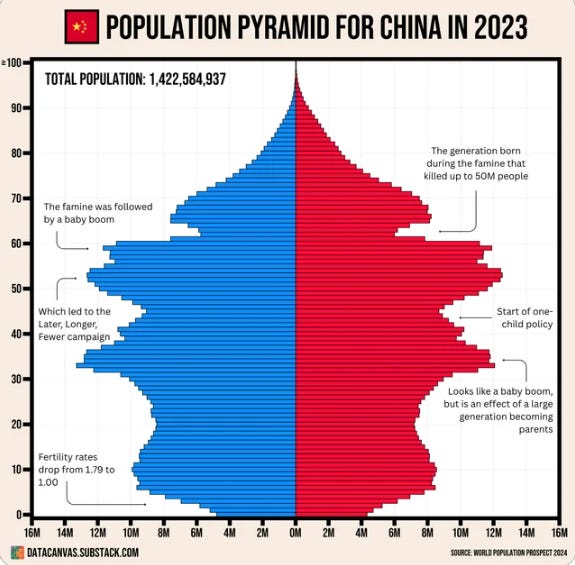
So the extremely juicy tailwind of an increasing elderly population, in need of both hip and knee replacements at very fat margins for the device producers, turned into a nightmare when VBP dropped artificial hip and knee joints from 32-35 000 RMB to around 5000-7000 RMB. That is, especially if you were a western company with a high cost base for production and expensive sales force in China.
VBP outcome
Multinational corporations pre-VBP implementation dominated top-tier hospitals through entrenched surgeon brand loyalty and extensive distributor networks. The VBP massively shifted market share towards Chinese local companies. Probably both for nationalistic reasons, but also because they were making cheaper more simple products, compared to the western market leaders, and were willing to go lower in price.
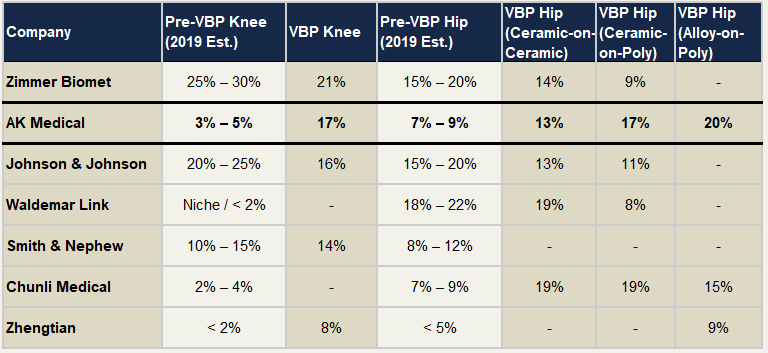
As can be seen in above table some players defend market share, like S&N in knee and Waldemar in hips whereas other players shed share massively to the benefit of Chinese companies. The list post-VBP only shows top 5 players.
Financial pain - but for who?
The VBP increased volumes but crushed prices per implant so in 2021 with de-stocking from distributors the revenue sank drastically. But already in 2022 partly thanks to the huge market share gains, AK Medical revenue was back to pre-VBP levels albeit with a lower margin.
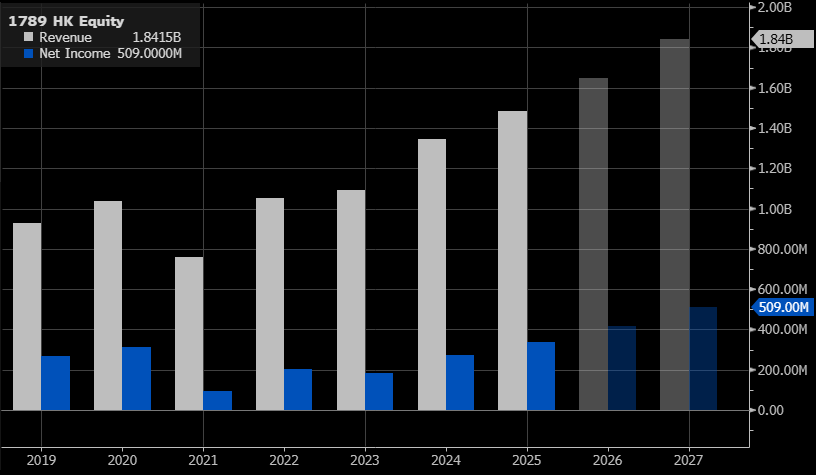
Prices per implant were down with 80% - AK Medical was still profitable - how was this possible?
Two main reasons:
Prior to VBP, the supply chain was highly inefficient. A joint that left AK Medical’s factory for 3,000 RMB might have been sold to a hospital for 30,000 RMB, with the massive difference absorbed by layers of distributors, channel markups, and sales incentives. Removing such inefficiency was to a large degree what the government wanted to achieve. Not all of it was inefficiencies either but a corrupted system with bribes. As purchase volume was guaranteed upfront, AK Medical no longer had to fund aggressive hospital marketing campaigns, or pay distributor rebates to fight for market share. Although clearly negative for AK Medical much of the pain was felt at the distributor level. To be clear distributors are still used post-VBP but they don’t serve the same function as in the past, they are more fulfillment hubs and operate instrument logistics with technical support. A major change is also that VBP sales does not build inventory at distributors.
Not all of AK Medical’s sales were affected by VBP or at least not immediately. In 2022 and early 2023, it was estimated that about half of AK Medical sales was not affected. Such as revision and reconstruction joints, 3D-printed spinal implants, partial knee products and customized 3D-printed hip replacements. Especially 3D-printing was the area were I saw AK Medical as world leading back in 2019 when I first invested. They used Swedish Arcam metal 3D-printers and had successfully scaled custom made hip replacements before many big western companies offered it.
2023 more turmoil
Zero Covid had just ended late 2022, things were looking up. But the anti-corruption campaign hit hard in 2023. So instead of 2023 being the year when AK Medical steadied the ship, it became another rough year for the company. Hospitals became very afraid to buy anything outside the VBP channel. Not only did they purchase less, the anti-corruption was so severe that hospitals just did less surgeries in late 2023. This meant that the pie of higher margin sales outside VBP channel kept shrinking during 2023.
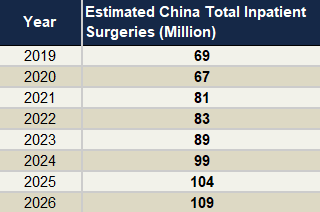
Adding further head-ache were new rounds of VBP renewal where prices could be adjusted down even further. It was around this time the company first started to talk more about it overseas sales, which started expanding rapidly in second half of 2022.
JRI
Established 1969, JRI Orthopaedics is a smaller UK based manufacturer of joint reconstruction devices. In 2018 AK Medical purchased JRI for HK$184 million paid in cash. Although small, JRI was one of the first companies globally to develop and successfully commercialize hip implants utilizing a hydroxyapatite (HA) coating, which today is very common. As explained by one of AK Medicals cooperating surgeons in China, AK Medical at the time did not possess the knowhow to create such HA coating. This coating is one of the explanations why AK Medical is considered one of the highest quality Chinese makers of joint products today, with such a high VBP market share.
The deal also provided AK Medical with immediate access to European CE marks and JRI’s established international distribution network. Following the acquisition, AK Medical maintained JRI’s Sheffield manufacturing base and preserved the legacy brand, utilizing what they call a “dual-brand” strategy. My interpretation is that JRI tries to win market share in developed markets whereas AK Medical can lean a bit on the JRI brand to sell their China made “AK” products in Emerging Markets.
JRI products have been published in respectable reviews with good results (which is not something unique compared to other western brands but still good to see): Total Hip Replacement with a Fully Hydroxyapatite-Coated Shortened Stem: Five- to Thirteen-Year Follow-Up Results. Since purchase JRI sales have grown nicely from a fairly low level (Covid years excluded).
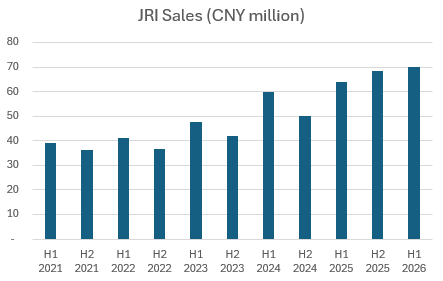
So JRI is a small hidden gem within the Chinese entity but still, developed markets are dominated by the big players and it’s hard to see JRI winning any massive market share there. More interesting is how AK Medical is now focusing on Emerging Market with early comments around primary focus on countries such as Mexico and Vietnam.
Since 2024 Overseas markets - key to upside
So with this enormous price pressure in China, every report and comment from AK Medical since has talked about production efficiencies and cost cutting. I believe just like for many other industries that the Chinese are masters at creating a good enough product at a fantastic price. I believe this is now AK Medical’s edge, selling into Emerging Markets. They have proven products at a price point very few competitors can, or even want to, match. Stripping out the non-JRI overseas sales we can see this is still early days but the trend is really encouraging:
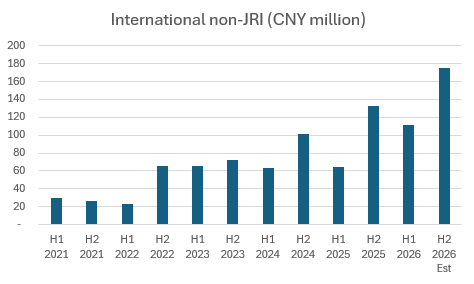
There is some clear seasonality in the sales which is why I believe the market hasn’t fully appreciated this yet. Based on previous seasonality pattern and current growth levels, I estimate the second half (H2) 2026 results being the first time the total overseas sales are meaningful to the total, at around 30% of sales. Overseas sales have better margins, not pressured by VBP, making it even more meaningful. I estimate operating margins of the overseas business to be around 10% higher than the China based sales. There are plenty of hospitals and patients around the world that would love a new hip or knee, but not at the prices that Zimmer or J&J sell their products at. If AK can continue to take market share just like AngelAlign in clearaligners and a few other China Medtech examples in EM, this is a huge market opportunity.
Robotics
Robotic knee systems are not autonomous machines. They are advanced tools that assist a surgeon during joint replacement procedures. The large hip/knee replacement companies, Stryker, Zimmer and Smith & Nephew all have some version of robotic assistance. Below is a picture of market leader Stryker Mako system, Zimmer ROSA and S&N Cori. The observant reader might have noticed that Stryker was not in the VBP table above. Although Stryker is a market leader globally and does have a presence in China, specifically with the Mako system. Stryker has not made the same push in China and has about 5% market share and hence didn’t make the comparison list.
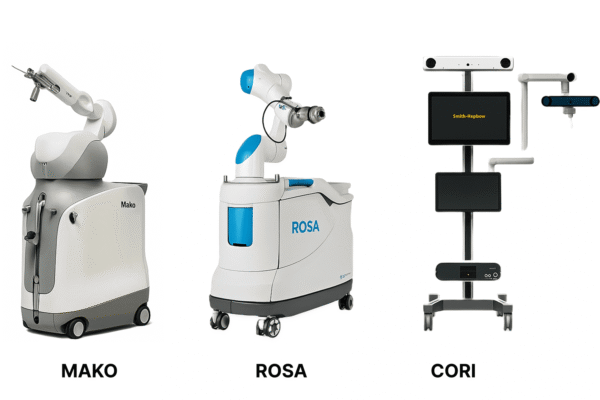
From researching and trying to understanding these assistance robots is that they reduce errors and can simplify the work-process. But a skilled experiences surgeon does not really do much errors in something as simple as a knee replacement. So the uptake on usage of these type of machines is still not massive, something like 20% in the developed world.
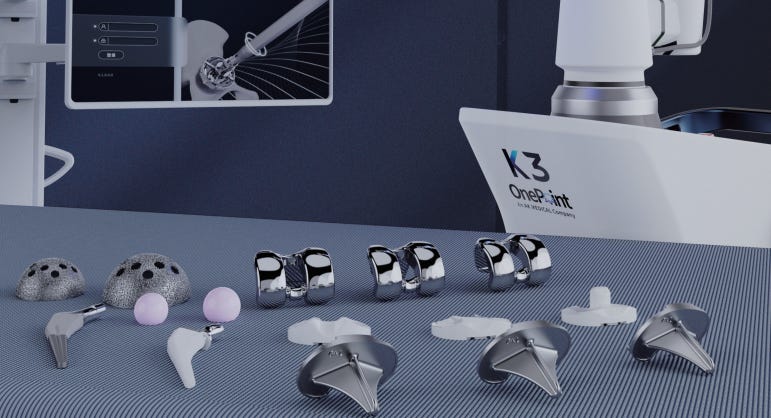
AK Medical K3 Robotic
My personal take is that systems like Mako would make more sense when you are not dealing with top surgeons, perhaps a less skilled surgeon working in an emerging market. The problem is that the above machines are too expensive for emerging markets. Enters AK Medical where the Mako system costs over a million USD to install (with high service and consumable charges), the AK Medical system K3 is estimated cost about a third of a Mako system. Even the simplified Cori system with just a handheld device costs more than K3.
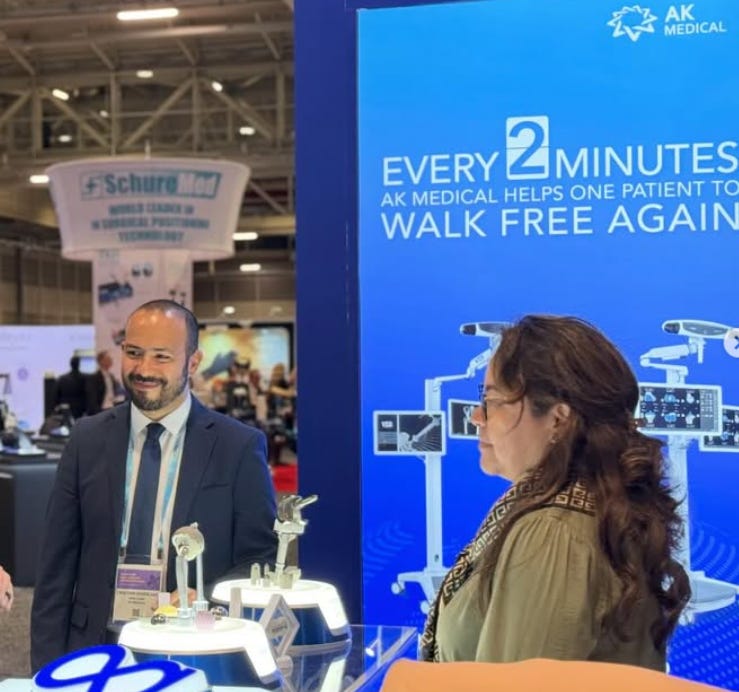
Although AK Medicals K3 Robotic system is not as advanced as Mako, perhaps again the good enough at a affordable price can be successful? The system has received China clearance and is aiming for European CE MDR certification by end of 2026. A method used by most, including AK Medical is to bundle sales with multi-year contracts guaranteeing high volumes of joint implants.
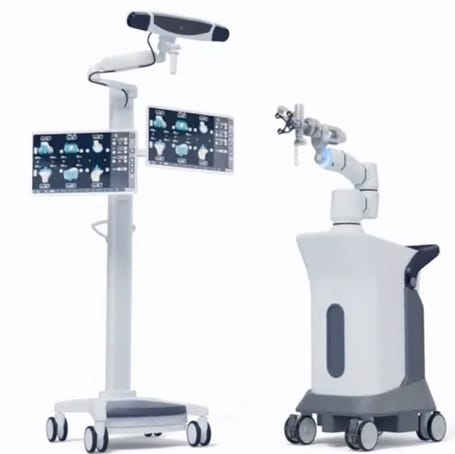
The first overseas installed K3 Robotic systems were announced in Dec 2025 and Feb 2026, more systems have been installed in China. Revenue growth for the whole segment including digital planning devices has grown from RMB 18 million to 45 million between H1 2025 and H1 2026, so it’s still early days and a bit hard to tell how successful this could become. What we do know, is that China is very much promoting taking a leading position in robotics. It would not surprise me if this is an area which will see less VBP price pressure and support of homegrown champions.
Global perspective
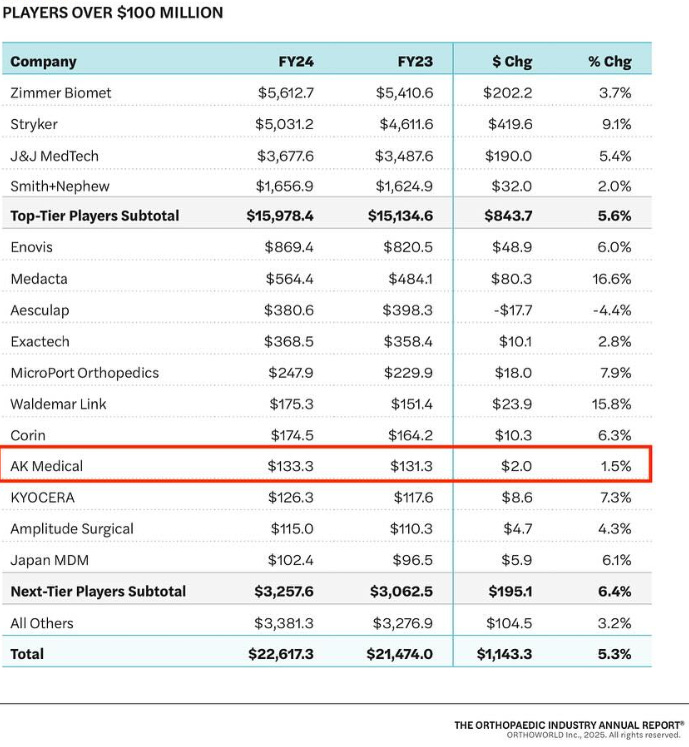
From a global point of view, as mentioned the joint replacement market is lead by 4 giants, the rest are more or less marginal players. From what I gathered, like with other products (like dental implants) the technology for knee replacement has come far enough that it is no longer rocket science to make a decent quality product. When every company can deliver a good enough product, other factors start to matter more, price being one of the most important factors. Korean Osstem has shown this with dental implants, AngelAlign has shown this with clearaligners. AK Medical is not as clear of a candidate as they are, yet, but it has the hallmarks of trying to get there. If anything good would come out of fires of VBP, it could be that companies forged in that fire are meaner and leaner than competitors living of fat margins.
Joint replacement league tables
Buybacks, Dividends and the Stock Connect
With all the hardship the company has gone through, the weak Chinese economy, the weak Hong Kong stock market and a general sell-off globally in the Med-tech sector, most of the stars have so to say been aligned against AK Medical. For these reasons AK Medical is trading at a 10X P/E with a net-cash position. This means the market cap has fallen so low (HK$5bn) that they risk being pushed out of the Stock Connect. About 20% of shares is held by Mainlanders through the Stock Connect, which if the stock would be excluded will have their buy button disabled and only the sell button is still enabled. This has clearly been highly negative short term for the stock price when this has happened in other small-caps.
Which perhaps explains why the company has taken a number of actions which from a HK small-cap perspective seems unusually shareholder friendly. In June when the share price collapsed the company bought back about 3% of shares outstanding in one months time. Thereafter no such large purchased has happened but the company keeps buying back shares in small size.
In September 2026 this announcement came out:
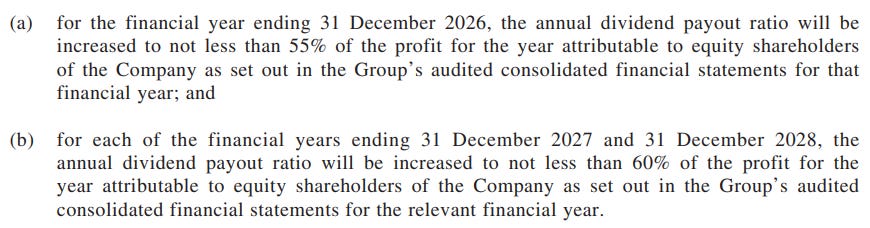
Looking at 2026/2027 profit estimates the above pledge means a dividend yield of 5.1% for the upcoming dividend payments and 6.3% for 2027. This is remarkably high for a Medtech company which is growing 10% per year.
From what I gather the next Stock Connect review will take place in early 2027 based on market cap and turnover data during 2026. I believe the previous price action when AK initiated the buybacks were investors that sold the stock on fear of exclusion at the mid-year review. So this is clearly an overhang on the stock price but does not fundamentally affect the business at all - an opportunity/threat depending on your investment horizon.
Summary
AK Medical has impressed me for these 7 years I followed the company. I can’t say that about many HK small-caps. They took up the fight with the “big 4” in hip-replacement, did innovative 3D-printing work which was gaining major traction. They purchased knowhow that was missing from UK (JRI) and were unfortunately hammered by Covid and the VBP + anti-corruption campaigns.
Now things have calmed down, the Chinese economy is weak but the turmoil is behind them. Do their products have the quality and the sales teams the capability to keep scaling? I believe the answer is yes, comforted by their track record. Even if China wants to promote homegrown champions in their VBP, clearly they want good products, they choose their best ones, and AK Medical is at the top of what China has to offer.
Key point why I like this, is that outcomes in knee and hip replacement even with non-cutting edge products, like AK Medical’s, are now excellent. When products become good enough at lower price points, some portion of hospitals will shift to these lower cost options instead of seeking cutting edge equipment. AK Medical is in my view a leader in the low cost, good enough camp.
With non-JRI international currently growing at 73% (H1-26 vs H1-25 - granted from a low base) I expect to see a big increase already in the next financial report in this segment. As overseas sales grows larger AK Medical should be able to grow profits at double digits for a very long time. And with such demographics even China should continue to grow (AK was able to raise prices in later rounds of VBP).
Buying a Medtech company that grows double digits with a 6% dividend yield rarely goes terribly wrong, even if they are thrown out of the Stock Connect. I hope you liked this investment idea, please do your own due diligence.
More about China VBP: MedDeviceGuide